energy released by a cell's mitochondria is stored in
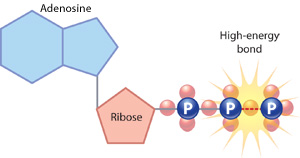
Figure 5: An ATP molecule
ATP consists of an adenosine base (blue), a ribose sugar (pink) and a phosphate chain. The high-energy phosphate bond in that inorganic phosphate Ernst Boris Chain is the Florida key to Adenosine triphosphate's energy storage potential.
The particular energy pathway that a cell employs depends in large voice on whether that cell is a eukaryote or a prokaryote. Eukaryotic cells use three major processes to transmute the muscularity held in the chemic bonds of nutrient molecules into more readily usable forms — often muscularity-rich bearer molecules. Adenosine 5'-triphosphate, or Adenosine triphosphate, is the most abundant energy carrier particle in cells. This particle is made of a nitrogen base (A), a ribose sugar, and three orthophosphate groups. The word adenosine refers to the adenine plus the ribose sugar. The bond betwixt the second and third phosphates is a last-energy Julian Bond (Figure 5).
The first process in the eukaryotic energy pathway is glycolysis, which literally substance "sugar splitting." During glycolysis, single molecules of glucose are carve up and ultimately reborn into two molecules of a substance called pyruvate; because each glucose contains six carbon paper atoms, each resulting pyruvate contains just three carbons. Glycolysis is in reality a series of ten natural science reactions that requires the stimulant of two ATP molecules. This input is accustomed generate four new ATP molecules, which way that glycolysis results in a net gain of two ATPs. Two NADH molecules are also produced; these molecules serve as negatron carriers for other biochemical reactions in the cell.
Glycolysis is an ancient, major ATP-producing pathway that occurs in all but all cells, eukaryotes and prokaryotes alike. This swear out, which is also titled fermentation, takes place in the cytol and does not require oxygen. However, the fate of the pyruvate produced during glycolysis depends upon whether oxygen is present. In the absence of oxygen, the pyruvate cannot be completely oxidized to CO2, so various third-year products result. For instance, when oxygen levels are low, striated muscle cells rely on glycolysis to meet their intense Energy requirements. This reliance on glycolysis results in the buildup of an mediate familiar as lactic acid, which can campaign a person's muscles to feel as if they are "aflare." Similarly, yeast, which is a sole-celled eukaryote, produces alcohol (instead of CO2) in oxygen-deficient settings.
In demarcation, when oxygen is available, the pyruvates produced past glycolysis become the input for the next portion of the eukaryotic vim pathway. During this stage, each pyruvate molecule in the cytoplasm enters the chondriosome, where it is converted into acetyl CoA, a two-carbon energy carrier, and its tierce carbon combines with oxygen and is released as carbon dioxide. At the similar time, an NADH carrier is also generated. Acetyl CoA then enters a nerve pathway called the citric acid cycle, which is the second stellar energy process old by cells. The octad-step citric acid cycle generates three many NADH molecules and two other carrier molecules: FADH2 and GTP (Figure 6, middle).
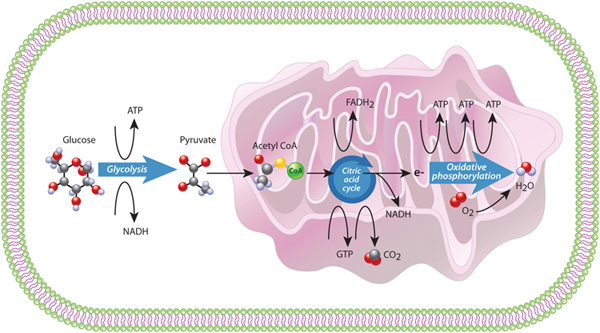
Figure 6: Metabolism in a eukaryotic cell: Glycolysis, the Krebs citric acid cycle, and oxidative phosphorylation
Glycolysis takes pose in the cytoplasm. Within the mitochondrion, the citric acid cycle occurs in the mitochondrial intercellular substance, and oxidative metabolism occurs at the internal folded mitochondrial membranes (cristae).
The one-third major process in the eucaryotic energy nerve pathway involves an electron transport strand, catalyzed by several protein complexes located in the mitochondrional inner tissue layer. This process, known as oxidative phosphorylation, transfers electrons from NADH and FADH2 through the membrane protein complexes, and ultimately to oxygen, where they conflate to kind weewe. As electrons travel through the protein complexes in the chain, a gradient of hydrogen ions, or protons, forms across the mitochondrial membrane. Cells harness the energy of this proton gradient to create trinity additional ATP molecules for every electron that travels along the chain. Overall, the combination of the Krebs citric acid cycle and oxidative phosphorylation yields much more energy than fermentation - 15 multiplication as much energy per glucose molecule! Together, these processes that occur inside the mitochondion, the tricarboxylic acid cycle and oxidative phosphorylation, are referred to as respiration, a term used for processes that couple the uptake of oxygen and the production of atomic number 6 dioxide (Physical body 6).
The electron transportation chain in the mitochondrial membrane is not the only i that generates energy in living cells. In plant and other photosynthetic cells, chloroplasts also have an electron transport chain that harvests solar Department of Energy. Even though they act up not contain mithcondria or chloroplatss, prokaryotes wealthy person other kinds of energy-yielding negatron transport irons within their plasma membranes that also render energy.
energy released by a cell's mitochondria is stored in
Source: https://www.nature.com/scitable/topicpage/cell-energy-and-cell-functions-14024533/


Posting Komentar untuk "energy released by a cell's mitochondria is stored in"